
Let me tell you something nobody in the “start a business” space likes to admit: you can start a online business for free.
Most beginner online shop advice assumes you already have a product, a supplier, a budget, and at least a basic idea of what you’re doing.
But what if you have none of those things?
What if you want to start something you can feel that pull towards building your own income but you genuinely don’t have the money to buy stock, you have no idea what to sell, and the whole thing feels so overwhelming you’ve talked yourself out of it three times already?
That’s what this post is for.
Because there is a way to start an online shop with literally zero upfront cost. No stock to buy. No warehouse. No minimum orders. No risk of ending up with 500 mugs in your spare room.
If you’re curious about how to take the first step, read on to discover how to start a online business for free without the usual barriers.
It’s called print on demand and it might be the most beginner-friendly way to start selling online that exists right now.
What Is Print on Demand (And Why Should You Care)?
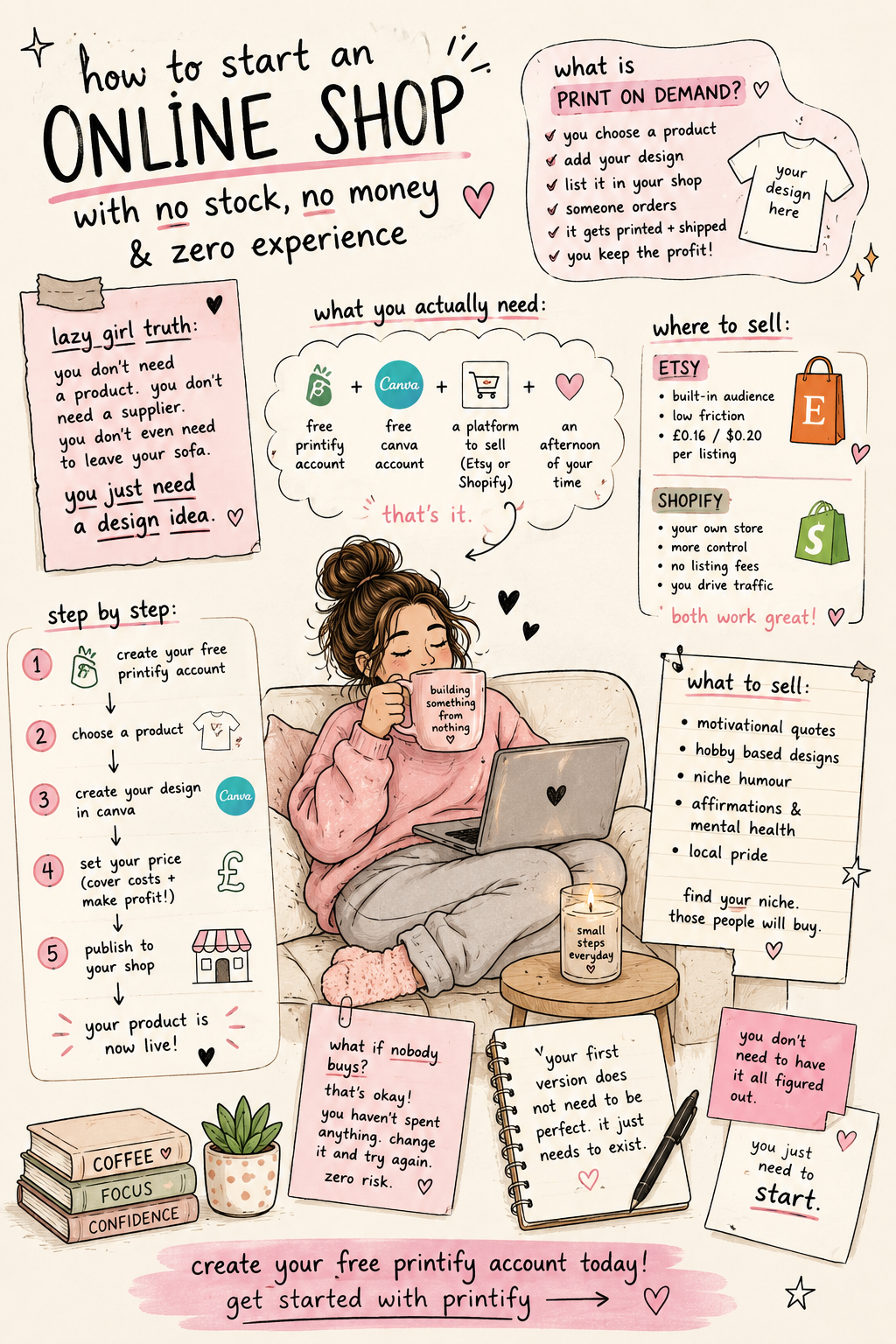
Print on demand often shortened to POD is a business model where products are only made when someone orders them.
Here’s how it works in plain English:
- You choose a product (a t-shirt, mug, tote bag, hoodie, phone case there are hundreds of options)
- You add a design to it using a free tool like Canva
- You list it in an online shop
- When someone buys it, the print on demand company prints and ships it directly to them
- You keep the difference between what the customer paid and the base cost
You never touch the product. You never pay for it until it’s already been sold. You never need to worry about storage, packaging, or shipping.
And you can start for free.
Lazy Girl truth: You don’t need a product. You don’t need a supplier. You don’t even need to leave your sofa. You just need a design idea and a free account.
The Platform You Need: Printify
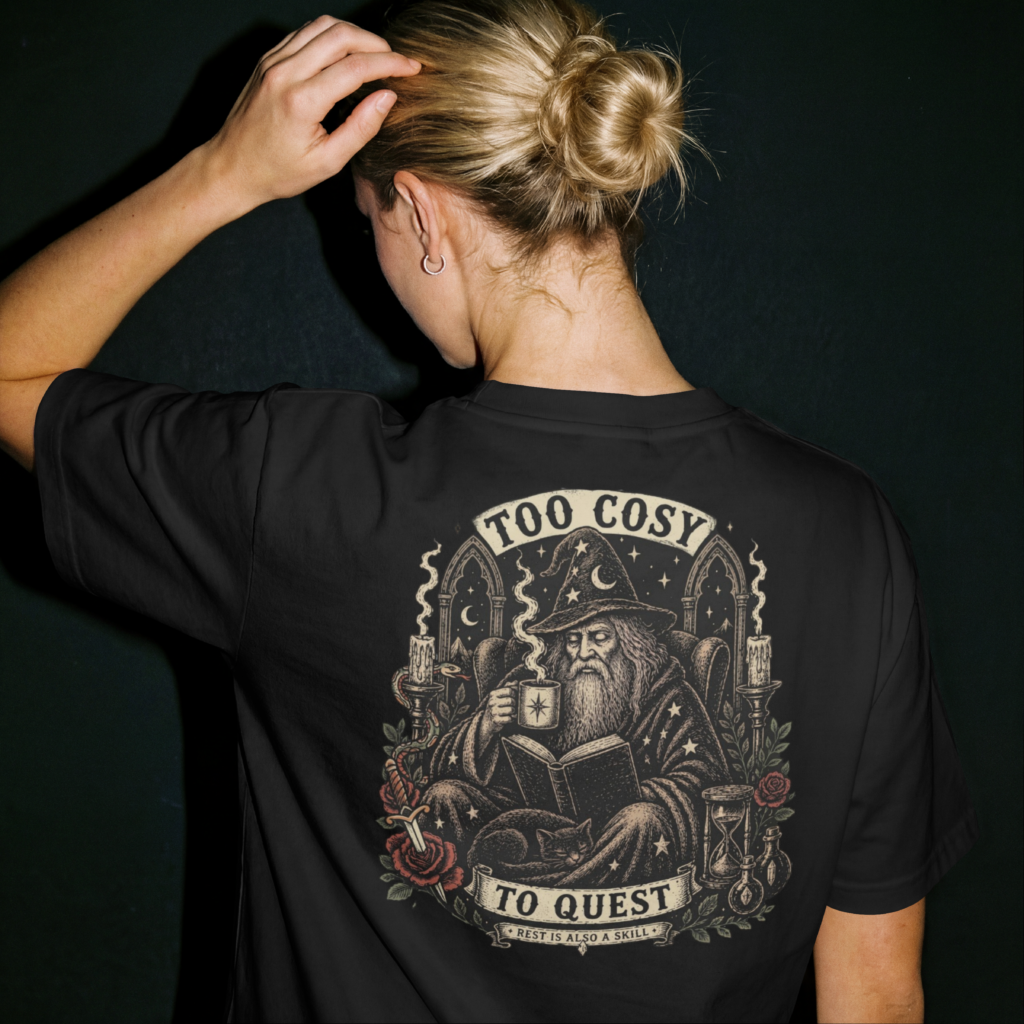
The print on demand platform I recommend for beginners is Printify. It connects to over 900 products, works with multiple sales platforms, and has a free plan that gives you everything you need to get started.
Printify acts as the middleman between you and the print providers. You create your products inside Printify, and when orders come in, Printify automatically routes them to be printed and shipped.
Remember, the aim is to create something meaningful as you start a online business for free.
The free plan lets you create up to 5 shops and list unlimited products which is honestly more than enough when you’re just starting out.
You don’t pay Printify anything upfront. You only pay the base cost of the product when a customer places an order, and by then you’ve already collected their payment. The difference is your profit.
What You Actually Need to Get Started
This is the bit where I want you to breathe. Because the list is short.
- A free Printify account
- A free Canva account (for creating your designs)
- A sales platform to sell through — more on this below
- About an afternoon of your time
That’s it. No investment. No experience required. No special skills.
If you can make a basic graphic in Canva and I promise you can, even if you’ve never tried you can create a print on demand product today.
You don’t need to be a graphic designer. Simple text-based designs (a quote, a phrase, a word in a nice font) sell extremely well on print on demand. Start simple.
Where to Sell Your Products
Printify integrates with several selling platforms, but the two most popular options for beginners are Shopify and Etsy.
Etsy is great if you want to take advantage of an existing marketplace with built-in buyers searching for exactly what you’re selling. There’s a small listing fee per product (£0.16 – $0.20) but no monthly subscription.
Shopify gives you your own standalone store. You have more control, better branding options, and no marketplace competition — but you’re responsible for driving your own traffic. If you want to go the Shopify route, you can
start a free trial here: PRINTIFY
How to Start a Online Business for Free
For absolute beginners, Etsy is often the lower-friction starting point. But the beauty of Printify is that you can connect to multiple platforms so you’re not locked into anything.
Sharing your journey of how you start a online business for free can inspire others to take the same leap.
Step by Step: Your First Product in Printify
Here’s the simplest possible path from zero to your first listed product:
Step 1: Create Your Free Printify Account
Head to Printify and sign up for free. No credit card required.
Step 2: Choose a Product
Click ‘Add new product’ and browse the catalogue. For your first product, keep it simple a classic unisex t-shirt or a white mug are both beginner-friendly and consistently popular.
Check the print provider ratings and shipping times before you commit. Printify shows you multiple providers for each product — choose one with good reviews and reasonable UK/EU shipping if that’s your main audience.
Step 3: Create Your Design
This is where Canva comes in. Head to Canva (free) and create a design at the dimensions Printify specifies for your chosen product. For t-shirts, this is usually around 4500 x 5100 pixels.
Don’t overthink your first design. A simple quote in a clean font on a white background is a perfectly valid starting point. Something like:
- “Tired but trying” perfect for the burnout generation
- “Small business big dreams”
- “Building something from nothing”
Once your design is ready, download it as a PNG and upload it to Printify’s design tool.
Step 4: Set Your Price
Printify shows you the base cost of the product. Your selling price needs to be higher than that — the difference is your profit.
A typical print on demand t-shirt might cost £10–£14 to produce. Selling it for £22–£28 gives you a reasonable margin while staying competitive.
Don’t undersell yourself. Buyers expect to pay for quality and custom products.
Step 5: Publish to Your Shop
Connect your Printify account to your chosen platform (Etsy or Shopify) and hit publish. Your product is now live.
What to Sell: Ideas to Get You Started
If you’re staring at a blank screen wondering what on earth to put on a t-shirt, here are some niches that consistently sell well for beginners:
- Motivational quotes for small business owners and side hustlers
- Hobby-based designs (bookish, plant parent, dog mum, coffee obsessed)
- Niche humour (teacher humour, nurse humour, “I survived another meeting that could have been an email”)
- Affirmation-style designs for anxiety and mental health communities
- Local pride — town or county-specific designs
The key is finding a niche where people have a strong identity and like to express it. Those people buy.
Don’t try to appeal to everyone with your first product. The narrower your niche, the easier it is to find buyers who actually want what you’re selling.
Common Questions Beginners Ask
Do I need to register as a business?
If you’re just starting out and making a small amount, you don’t necessarily need to register immediately but you should look into your local rules around sole trader registration and tax as soon as you start making consistent sales. In the UK, you’ll need to register as a sole trader with HMRC if you earn over £1,000 in a tax year.
What if nobody buys?
That’s okay. Because you haven’t spent anything. That’s the whole point of print on demand — zero-risk testing. If a design doesn’t sell, you change it. No loss. No wasted stock.
How long does it take to start making money?
Honestly? It varies massively. Some people make their first sale in week one. Others take a few months. It depends on how much effort you put into marketing and how well your niche resonates.
Print on demand is not a get-rich-quick model. It’s a low-risk, build-over-time model. Be patient with it.
Your Next Step
You don’t need to have it all figured out. You don’t need the perfect design or the perfect product.
You just need to start.
Create your free Printify account here: Get started with Printify → — and give yourself permission to figure it out as you go.
“Your first version does not need to be perfect. It just needs to exist.” — Lazy Girl Builds