
If you’ve spent any amount of time researching how to start an online shop as a beginner, you’ve probably reached that exact moment where every browser tab starts blending into one giant mess. You begin with a simple question. You just want to know how to build a website and start selling something online. Maybe it’s a side hustle. Maybe it’s print on demand. Maybe you’ve got dreams of escaping your day job and building something that’s actually yours. Then suddenly you’re two hours deep into YouTube tutorials, someone is passionately arguing about website architecture, another person is using words like “scalability” and “ecosystem flexibility”, and you’ve somehow ended up watching a thirty-minute comparison video while stress-eating biscuits. If you are a beginner looking for guidance, understanding the differences between platforms such as Shopify for beginners and WooCommerce can significantly streamline your journey.
The question that started all of this was simple.
Shopify or WooCommerce?
The internet acts like this is some kind of business personality test. Team Shopify and Team WooCommerce seem ready to defend their chosen platform like they personally built it. One side tells you Shopify is the easiest thing in the world and you’d be mad not to use it. The other tells you WooCommerce is superior because you own everything and have complete control. Then someone appears recommending three other platforms you weren’t even considering and now you want to shut the laptop and pretend none of this happened.
Here is the truth that would have saved all of us some time.
Both are good.
Both work.
Both have built incredibly successful businesses.
The right answer depends less on what the internet says is “best” and far more on what actually suits you. Your budget matters. Your confidence with tech matters. Your goals matter. Whether you want a quick shop or a long-term content business matters. Most importantly, your tolerance for faffing around with settings absolutely matters.
Because if there is one thing I have learned while building side projects and trying every shiny business tool the internet swears will “change your life”, it is this. Easy is different for everyone.
Some people would rather pay a monthly fee if it means they never have to think about hosting, updates or technical setup. Other people would rather save money and spend an extra hour setting something up if it means keeping more of their income later. Neither approach is wrong. One just suits your personality better.
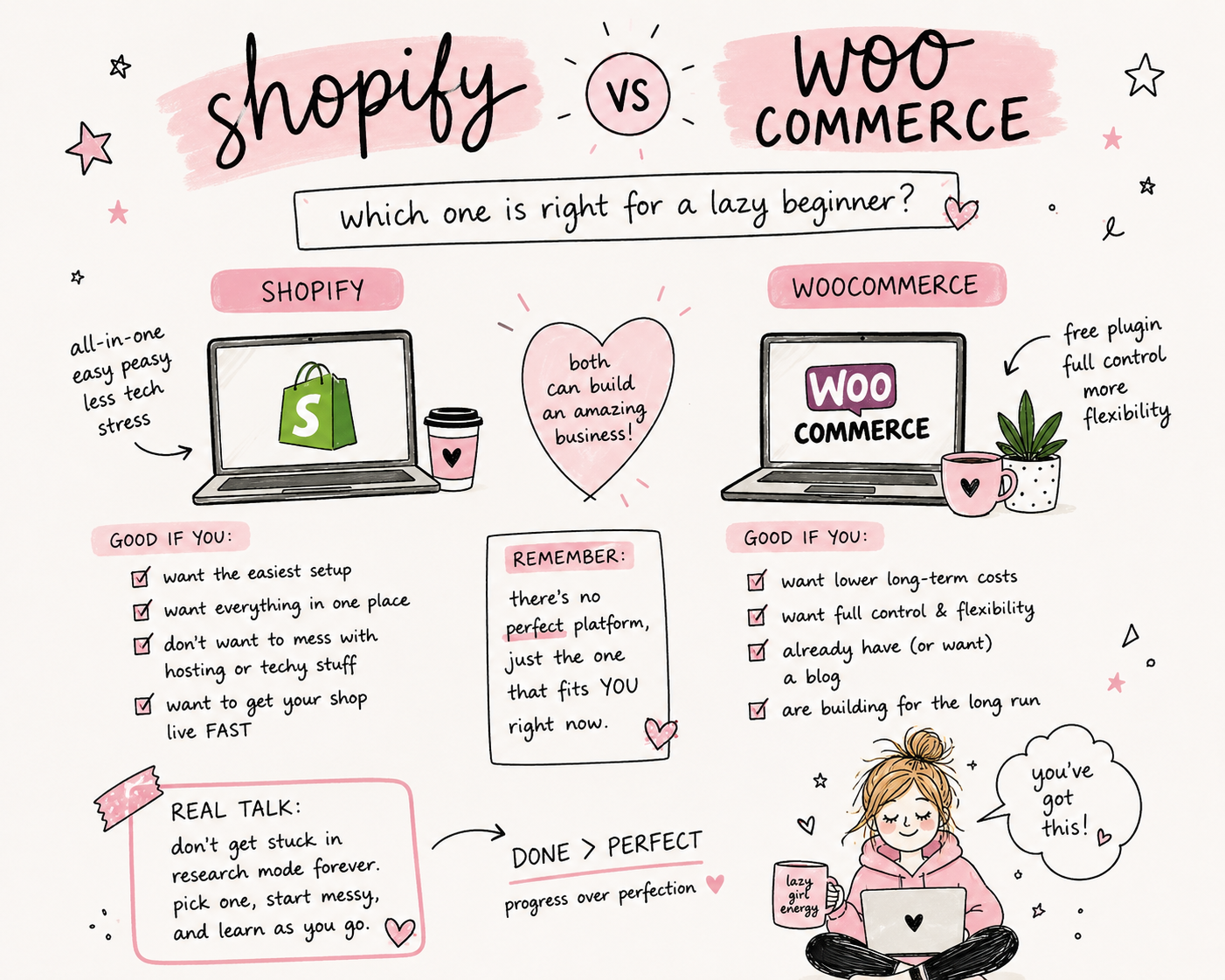
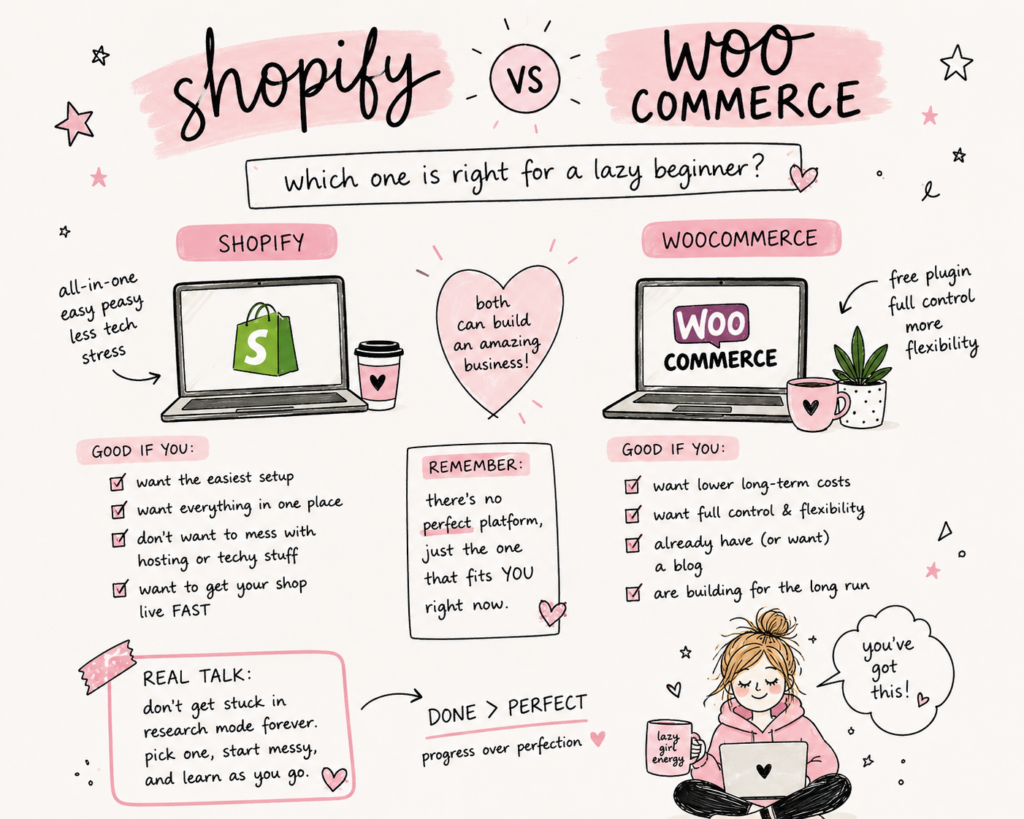
If you want the very short version before we dive in properly, here it is. If your goal is to get a shop online as quickly as possible with the least amount of stress, Shopify is probably your winner. If you want a blog, lower long-term costs, more flexibility, and the ability to build a bigger content-led business around your shop, WooCommerce starts becoming really interesting.
Shopify for Beginners: A Quick Guide
Still with me? Good. Let’s make sense of this properly.
Shopify is probably the easiest platform to explain because the whole point of it is simplicity. Shopify is essentially an all-in-one ecommerce platform. You sign up, pay a monthly subscription, and Shopify gives you nearly everything in one place. Your website lives there, your shop lives there, your dashboard lives there, your payments run through there, and most of the technical work quietly happens behind the scenes while you focus on building your business.
This is why beginners often fall in love with Shopify. There are fewer moving parts. You are not trying to work out hosting providers, security updates, plugin conflicts or whether you accidentally clicked something that just broke your homepage. You log in and start building.
Honestly, there is something very appealing about that.
You can see why Shopify has become so popular with first-time business owners. Starting a side hustle already feels overwhelming enough. There are products to think about, branding, content, social media, pricing and approximately six hundred moments where imposter syndrome suddenly appears from nowhere. Reducing technical stress is a pretty attractive option.
If you want to start with Shopify, you can grab the free trial here
The biggest advantage Shopify has is speed. You can genuinely get a basic shop online incredibly quickly. Not perfect. Not polished. Not ready to become a seven-figure business overnight. Just live. Sometimes that matters more than people realise. There is a lot of value in momentum and getting something out into the world instead of endlessly researching.
But this is where I have to give you the less glamorous side too.
Shopify looks affordable initially. Then little things start appearing. You want email marketing. Maybe reviews. Maybe upsells. Maybe subscriptions. Suddenly there is an app for this and an app for that and another monthly cost appears. Before long your little collection of “small” expenses starts becoming a bigger number than you expected.
It is not necessarily expensive. It is just worth knowing that those costs can creep up quietly.
WooCommerce works very differently.
WooCommerce itself is actually free. People often miss that part because they hear “WordPress” and immediately assume it sounds technical. WooCommerce is simply a plugin that transforms a WordPress website into an online shop. Think of WordPress as the house and WooCommerce as the extension that turns one room into a shop.
Before you panic and close this page because the word hosting appeared, stay with me.
Yes, you need hosting for WordPress. Yes, there are a couple more setup steps. No, it really is not as terrifying as people make it sound.
You install WordPress, add WooCommerce, follow the setup wizard and suddenly you have a shop.
That is genuinely most of it.
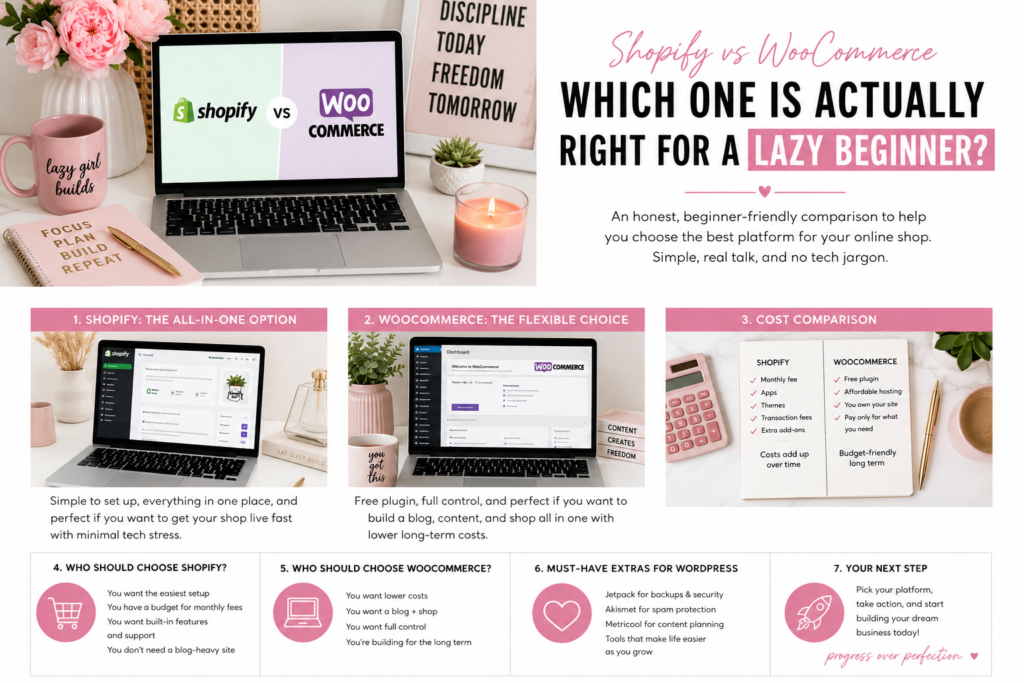
The reason WooCommerce becomes so attractive is not because it is prettier or somehow more magical than Shopify. It is because of flexibility and cost. If you are trying to build a side hustle with a limited budget, those monthly subscriptions matter. WooCommerce itself costs nothing. Hosting can be incredibly cheap. Over time, especially as your business grows, those savings become very noticeable.
There is another reason people often overlook too.
Blogging.
If your plan is purely selling products and nothing else, Shopify is perfectly fine. But if your business plan looks anything like mine and includes blogging, Pinterest, affiliate links, SEO traffic and creating content that slowly brings people to your website over time, WordPress absolutely shines.
WordPress was built around content.
Shopify technically has blogging functionality, but saying Shopify is a blogging platform feels a little like saying instant noodles are fine dining. Technically true. Not exactly the experience you were hoping for.
If your long-term vision includes building traffic through search engines and content creation, WooCommerce suddenly becomes much more attractive.
Because this is where people often make a mistake. They think they are choosing a website platform when really they are choosing how they want their entire business to grow.
That sounds dramatic but it is true.
Now let’s talk money because this is where beginners often decide.
Shopify starts around twenty-five pounds a month. By the time you add annual costs, apps, themes and extras, you can easily find yourself spending a few hundred pounds each year.
WooCommerce, on the other hand, can cost a fraction of that. Hosting through something like Hostinger can start around the cost of a couple of coffees each month.
That difference matters.
Especially if you are building a side hustle while paying bills, trying to clear debt, saving money or attempting to create financial freedom without throwing cash at every business tool Instagram tells you to buy.
I have learned this lesson the expensive way.
Not every shiny tool deserves your money.
Not every subscription deserves a place in your business.
The internet loves convincing beginners they need an entire digital toolkit before they even start. Fancy software. Analytics dashboards. Premium themes. Endless subscriptions.
You do not.
Please hear me on this.
You do not need a business that costs hundreds every month before it earns a single pound.
Start smaller.
Build gradually.
Add things when you actually need them.
For example, once your website grows you might eventually use tools like Jetpack for backups and security, Akismet for spam filtering, or Metricool for content planning if you are juggling blog posts, Pinterest, Instagram and social media scheduling.
Those things become useful eventually.
Eventually.
Not immediately.
Because if I could save every beginner from one mistake, it would be this. Do not become a collector of business tools.
I say that as someone who absolutely became a collector of business tools.
Now for the answer people always want.
If I personally had no huge budget and wanted to build a long-term content business from scratch today, I would choose WooCommerce.
Not because Shopify is bad.
Shopify is genuinely brilliant.
But I like flexibility. I like lower long-term costs. I like owning my website and building a business around content. Blogging, Pinterest traffic, affiliate marketing and side hustles all fit naturally into WordPress.
But if I wanted a shop online tonight and the thought of touching hosting settings made me want to dramatically lie face down on the floor, I would choose Shopify every single time.
Because easy matters too.
There is no wrong answer here.
There is only the answer that gets you building instead of endlessly researching.
Because eventually another comparison article is not helping anymore.
It is procrastination dressed up as productivity.
Choose one.
Start messy.
Learn as you go.
That is how almost every successful online business starts anyway.